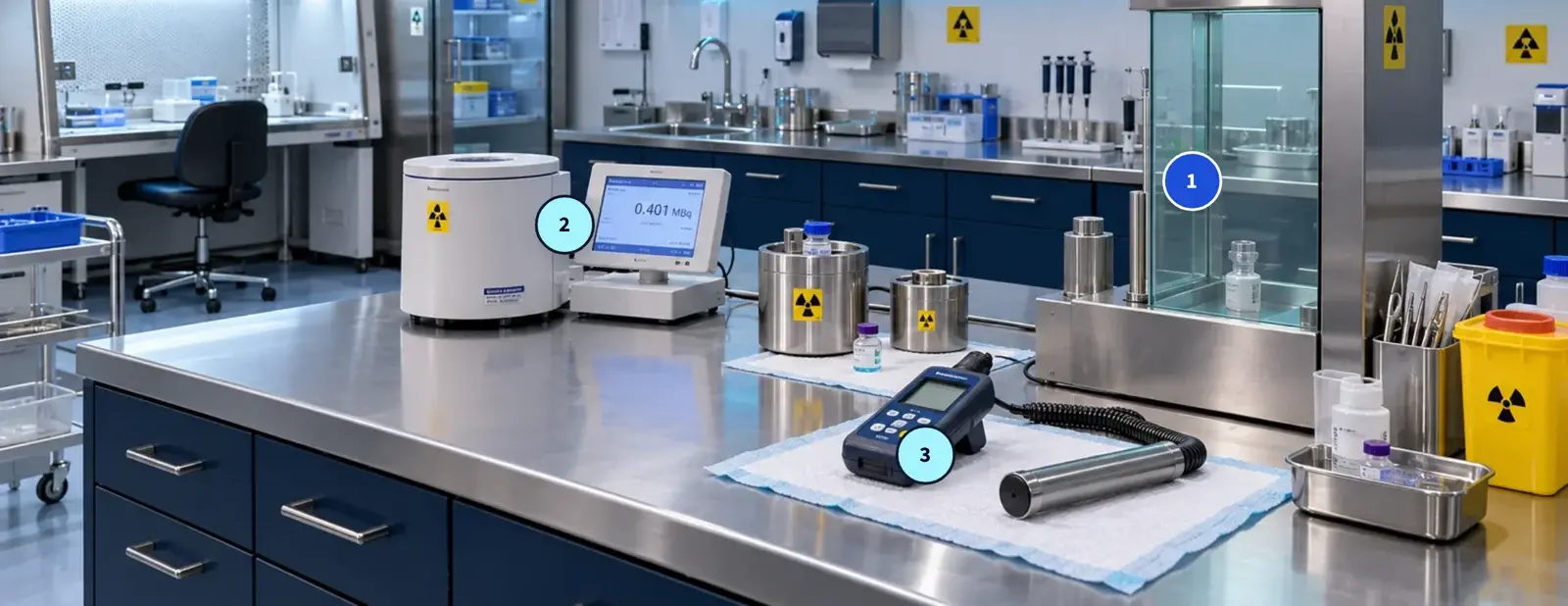
Free account. You go straight to the 3D hot lab after your profile.
Documentation + Implementation
PLUVICTO® Documentation & Implementation Support
Editable SOPs, treatment checklists, administration records, patient instructions, and a treatment ID card. We help adapt the documentation to your facility and support your team with training and workflow setup.
SOPs & supporting forms
Facility customization
Training & workflow setup
PLUVICTO only. Documents require facility customization and clinical approval before use.
Planning for Ac-225? Ask about preparation and staff training. Clinical implementation is subject to product-specific approvals, applicable licensing, and facility authorization.
Everything your program needs, connected.
One integrated platform and expert support for safe, well-documented care.
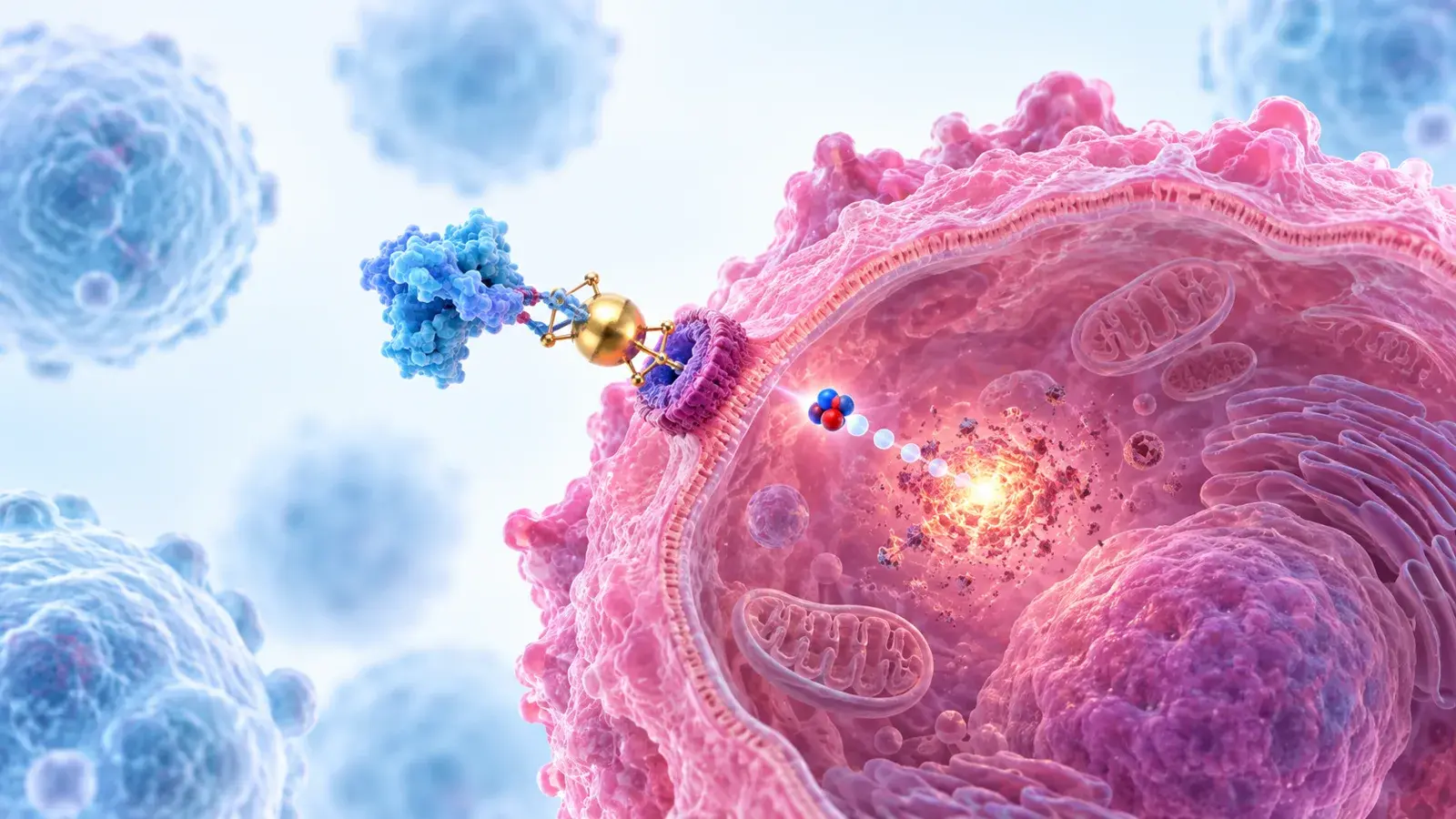
Ac-225 is a promising alpha emitter with the potential to deliver potent, targeted radiation to cancer cells. Research is ongoing to better understand its full potential, including safety, dosing, and practical use.
Ac-225 decays through a series of short-lived daughter isotopes that emit additional radiation, including alpha, beta, and gamma. These emissions can affect radiation safety, handling, and shielding considerations in clinical and research settings.
How Pb-212 compares
Pb-212’s decay chain includes a high-energy photon from Tl-208, making shielding considerations different from those for Tc-99m or Lu-177.
What changes for staff handling alpha emittersA short look at hands, spills and distance, from a 2025 radiation protection paper+
Alpha particles travel less than 100 µm, so once the drug is in the patient the exposure outside is very small. The risks sit in handling the dose, in a spill, and in how the injection is done.
Published estimates for 8 MBq of Ac-225, in a worst-case scenario.
Distance does most of the work
Estimated dose to the hand during an injection, for the same 120 seconds.
2.9 mSv
Holding it 5 cm away gives a hand dose about 1,100 times lower. This is why holders, tongs and a steady technique are part of the procedure.
Preparing a dose
About 120 s handling the vial and 300 s standing 30 cm away, with the vial in a lead holder.
Hand, at contact
48 µSv
Whole body, at 30 cm
0.28 µSv
Giving the injection
About 120 s with the syringe, 300 s at 30 cm. Beta-gamma shielding is recommended in this phase.
Hand, at contact
2.9 mSv
Whole body, at 30 cm
0.29 µSv
Caring for the patient
About 10 minutes at 50 cm after the injection, with no shielding.
Whole body, at 50 cm
0.21 µSv
If there is a spill
The skin matters more than the whole body. If the whole vial contents reached the skin, the paper estimates about 140 mSv spread evenly or about 67 mSv from a single drop, while the whole-body dose from decontaminating the floor is under 1 µSv.
The paper calls this deliberately conservative; it expects a realistic dose to be an order of magnitude or more lower. Gloves and a prompt response are what keep it there.
Shielding in practice
Lead holders for the photon emissions and plexiglass for the beta. The IAEA recommends shielding alpha emitters because of their X-ray and gamma emissions.
Double gloves, tools that add distance, and single-use equipment.
An absorbent pad around the injection site in case of a spill.
Read this as an illustration. These are published worst-case estimates, not measurements, built mostly on Ra-223 experience in a European setting. They are not a facility assessment, a shielding design, or a decision about whether anyone may be released. Your radiation safety officer and licence conditions decide those.
Source: Sarnelli A, Mezzenga E, Kollaard R, Winters EG, De With G, Mikołajczak R. Targeted alpha therapy in the clinical practice: radiation protection considerations. Eur Phys J Plus 140, 804 (2025). doi.org/10.1140/epjp/s13360-025-06709-y. CC BY 4.0. Values for 8 MBq of Ac-225 from the paper's Tables 4, 6, 10 and 11, shown in simplified form.

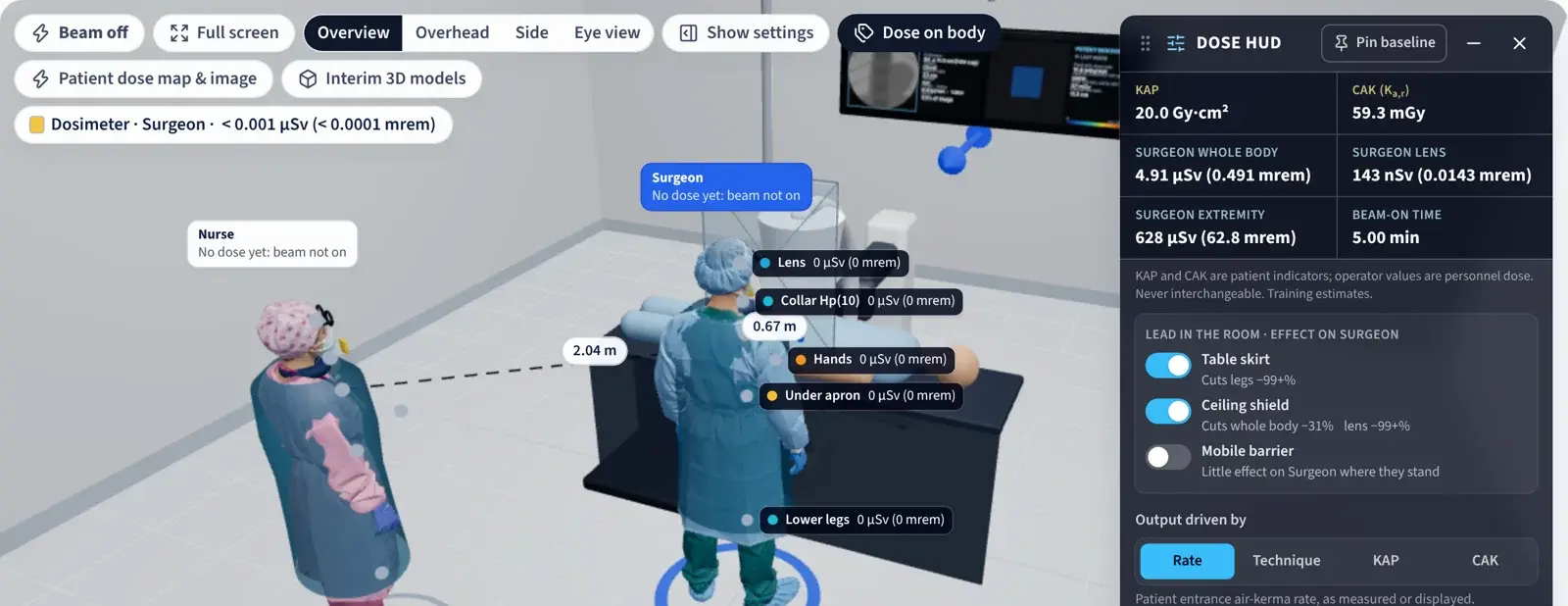 Screenshot from the simulator